


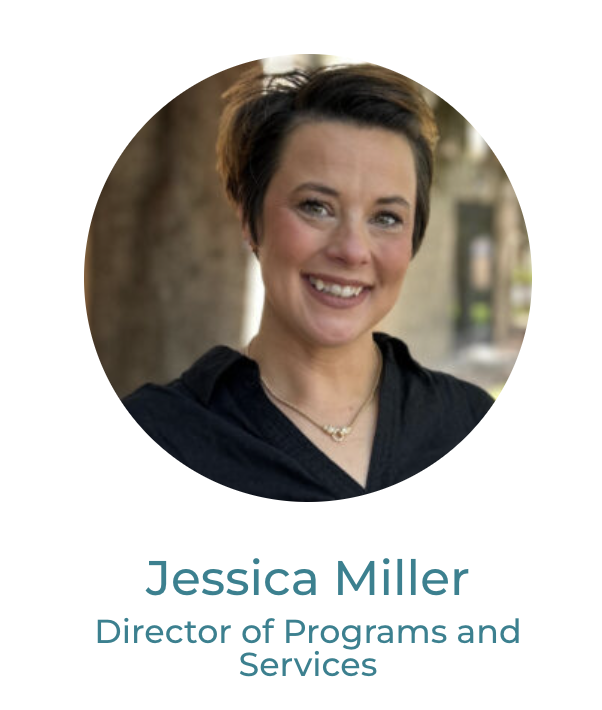
From the Desk of Jessica
Workplace accommodations and peer support helped me return to work after a traumatic brain injury (TBI). Today, I want to share my story and how the right support helped me build a career I love.
As the Director of Programs and Services at Connections for Independent Living, I am also a member of the disability community. I am neurodivergent, live with an autoimmune disease, and am a survivor of a traumatic brain injury.
After my injury, returning to work felt uncertain. At first, I did not know how to ask for accommodations. I also did not know what changes would help me most.
Thankfully, employment support helped me understand my needs and find ways to move forward.
How Peer Support and Workplace Accommodations Helped Me
The people I met along the way made the biggest difference.
Through services, I connected with peers who had faced similar challenges. I also met professionals who understood how to help.
Most importantly, they listened.
No one treated me like a number or a “case.” Instead, they took the time to understand my goals and what mattered to me.
Because of that support, returning to work became possible.
Six years ago, I set a goal to get the education and training I needed for a career in the nonprofit field. I wanted to use my experiences to help others.
Along the way, I also found a passion for teaching professionals about best practices. I wanted to help improve how people use complex systems, such as Medicaid.
Today, I am one semester away from completing my master’s degree. I am also proud to be part of the Connections team.
I chose Connections because we value listening, peer support, and personal choice. We believe each person is the expert on their own life.
What Workplace Accommodations Look Like for Me
If you visit my office, you will probably notice that I am wearing a hat.
For me, wearing a hat is not about looking casual. The gentle pressure feels like a hug on my head. On some days, that feeling helps me stay focused.
You may also notice that the lights in my office are kept low. This helps prevent headaches and eye strain.
In addition, my chair allows me to lean and stretch. That movement helps with joint pain caused by medication and years of wear and tear.
These are simple workplace accommodations. However, they make a real difference in my day.
No one questions why I need them or makes me feel uncomfortable.
To me, that is what an inclusive workplace looks like. It is a place where people can get the support they need to do their best work.
Workplace Accommodations Can Make a Difference
Many workplace accommodations are simple and cost little or nothing.
According to a 2025 report from the Job Accommodation Network (JAN), 61% of employers who shared accommodation cost information said their accommodations cost nothing.
For employers who reported a one-time expense, the median cost was $300.
Even so, people with disabilities continue to face challenges when looking for work.
The U.S. Bureau of Labor Statistics reported that in 2025:
- 22.8% of people with disabilities were employed.
- 65.2% of people without disabilities were employed.
- The unemployment rate for people with disabilities was about twice as high.
These numbers show why employment support and access to opportunities matter.
Why Peer Support Matters at Connections
Centers for Independent Living are built around the belief that people with disabilities should have a voice in the services they receive.
In fact, federal law requires that most staff and decision-makers at Centers for Independent Living be people with disabilities.
As a result, many of the people providing support understand these experiences firsthand.
At Connections, we believe peer support can help people build confidence, explore resources, and work toward their own goals.
My story is just one example of how much the right support can matter.
Share Your Story With Connections
I hope my experience encourages others to learn more about Connections and the services available.
Everyone has their own goals and their own path. Sometimes, having someone listen and offer support can make all the difference.
Have you had a positive experience with Connections that you would like to share?
With your permission, your story may be featured in a future newsletter or on our website.
References
Job Accommodation Network. (2025). Costs and benefits of accommodation. https://askjan.org/topics/costs.cfm
Rehabilitation Act of 1973, 29 U.S.C. § 796f-4. https://www.law.cornell.edu/uscode/text/29/796f-4
U.S. Bureau of Labor Statistics. (2026, March 3). Persons with a disability: Labor force characteristics, 2025 [News release]. https://www.bls.gov/news.release/disabl.nr0.htm
Stevens Amendment Funding Disclosure
This communication is supported by the Administration for Community Living (ACL), U.S. Department of Health and Human Services (HHS) as part of a financial assistance award totaling $146,511 with 10% funded by ACL/HHS and 90% funded by other Colorado state general funds and NGO source(s). The contents are those of the author(s) and do not necessarily represent the official views of, nor an endorsement by, ACL/HHS, the U.S. or State of Colorado Government.